LNEYA Refrigeradores industriais Fabricante Fornecedor


Instruções de funcionamento da câmara de ensaio a baixa temperatura
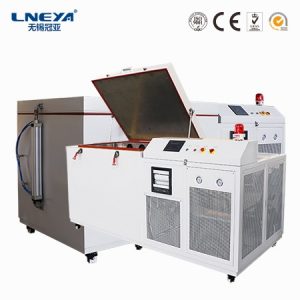
O low temperature test chamber is a necessary test equipment in aviation, automobile, household appliances, scientific research and other fields. It is used to test and determine the parameters and performance of electrical, electronic and other products and materials after the temperature environment changes in high temperature, low temperature, or constant test.
O low temperature test chamber can be used to check and determine the temperature cycling changes of electrical, electronic products or materials, and produce the adaptability of storage and use under environmental conditions. The equipment adopts forced air circulation to maintain the uniformity of temperature in the working room, with green environmental protection, micro-computer control, temperature digital display, adjustable temperature in the box, high-density insulation layer, good insulation effect, energy saving.
O low temperature test chamber should never be used for testing the following objects or those containing them:
(1) Explosives:
1. Nitroglycol (ethylene glycol dinitrate), nitroglycerin (propylene glycol trinitrate), nitrocellulose and other explosive nitrates.
2. Trinitrobenzene, trinitrotoluene, trinitrophenol (picric acid) and other explosive nitro compounds.
3. Peracetic acid, methyl ethyl ketone peroxide, benzoyl peroxide and other organic peroxides.
(2) Combustibles:
1. Spontaneous combustion:
Metals: lithium, potassium, sodium, yellow phosphorus, phosphorus sulfide, red phosphorus.
Cerules: calcium carbide (calcium carbide), phosphatized lime, magnesium powder, aluminium powder, sodium bisulfite.
2. Categories of oxide properties:
(1) Potassium chlorate, sodium chlorate, ammonium chlorate and other chlorates.
(2) Potassium peroxide, sodium peroxide, ingot peroxide and other peroxide salts.
(3) Potassium peroxide, sodium peroxide, barium peroxide and other inorganic peroxides.
3. Flammables:
(1) Ether, gasoline, propylene oxide, carbon disulfide and other substances whose ignition point is less than – 30 C.
(2) Common ethane, oxidized alkene, acetone, benzene, methyl ethyl ketone and other substances whose ignition point is above – 30℃ but below 0℃.
4. Flammable gases:
Hydrogen, acetylene, ethylene, methane, ethane, propane, butane and other gases that may burn at 1 atmospheric pressure at 15 C.
Recomendações relacionadas
-

O fabricante de congelação a temperaturas ultra-baixas analisa a causa do bloqueio do sistema de refrigeração
2040Com o desenvolvimento contínuo da tecnologia, a tecnologia de refrigeração de temperatura ultrabaixa também está em constante desenvolvimento e os fabricantes também estão a aumentar. Naturalmente, a tecnologia dos diferentes fabricantes é diferente. Uma vez que a refrigeração...
Ver detalhes -
Como instalar e utilizar o sistema de controlo da temperatura do reator?
1738Many users are going to start the installation after purchasing the reactor temperature control system. What should be paid attention to during installation? When installing the reaction kettle of the reactor temperature control system, it is nece...
Ver detalhes -
Failures of Heating Cooling Circulators
1553The heating cooling circulator can be used in many chemical pharmaceuticals and laboratories. Then, how to solve the failures of the heating cooling circulator?Failure of circulating pumpThe failure of the circulating pump is generally the heat ov...
Ver detalhes -
A importância dos compressores de refrigeração
1716In the operation of the precision chiller, the compressor is a more important part. If we want to understand the chiller, we have to understand the compressor. Most precision chiller compressors have a thermal switch inside. The function of this s...
Ver detalhes