LNEYA Refrigeradores industriais Fabricante Fornecedor


Solução de teste para pastilhas microfluídicas LNEYA
O teste do chip microfluídico é um programa para testar o chip de controlo da unidade. O dispositivo de teste de chip microfluídico LNEYA é especializado no processamento de vários testes de chip e tem certas vantagens para o desenvolvimento do ambiente de chip. A fim de i...
In order to improve the observability and controllability of each functional module, in order to verify the overall performance indicators of the chip to provide circuit structure support. The microfluidic chip test mainly consists of a screen, a driver chip, an FPC soft board, a power board, and an FPGA board. The screen and driver chip are based on practical applications, and have been soldered together during the test phase. With the screen, the driver and enable of the row and column can be visually displayed (excluding the dead pixels on the screen), and the Gamma correction for the chip, color scale The screen can be visually displayed, and the change process can be debugged online; then the screen and display control system are connected through the FPC soft board, and the screen voltage and control signal test points are reserved on the soft board; the power module realizes the display and the display on the screen. Voltage, and the total input of the driver chip power supply; the FPGA board is the control core of the entire test circuit, designing and storing some specific display effect images.
The circuit structure of the microfluidic chip test is based on the chip structure described above, and is designed with reference to its test requirements. The focus is on the power board and the FPGA board, and a power flow is provided for the entire test system to provide for each functional module. Adequate requirements for various thresholds, while preserving test points to monitor various AC and DC parameters of the driver chip. The other is to provide control and data flow of the test system, control the actions of each functional module, and independently create specific display data to verify the display effect of the driver chip.
The power supply of the microfluidic chip test system is divided into four parts: one part is the multi-channel power management VIN+5V required by the FPGA system, which is generated by the TPS5450. The second part drives the input voltage of the chip. After the LDO is stepped down, the core voltage and the 10 voltage VDDAB are generated. VDDI; three parts are the positive and negative high voltages required by AM-OLED. ELVDD and ELVSS are generated by TPS5450. The TPS5450 is characterized by different positive or negative voltages depending on the connection of the external inductor. In the fourth part, the voltage required for the level-shifting power supply is realized by the TPS65131. The power supply of the RGB row and column of the AM-OLED is adjustable from 4.6V to 6.5V, and a wide range of potentiometers can be used for flexible adjustment.
The microfluidic chip test interface is available in a variety of formats to facilitate conversion between multiple video data formats. The digital phase-locked loop is dynamically configurable to achieve clock multiplication, crossover, and phase locking, providing sufficient clock resources for the entire test system. In addition, the FPGA has a JTAG in-circuit debugging interface, which provides convenience for the configuration of the AM-OLED driver control chip register, and supports a variety of display formats and conversion functions, and provides sufficient resources for the verification of the functions of the AM-OLED drive control chip.
Microfluidic chip test as a complex control system, can also achieve the collaborative work of different modules through FPGA, can fully meet the various functional requirements of the test chip.
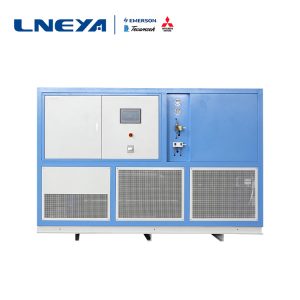
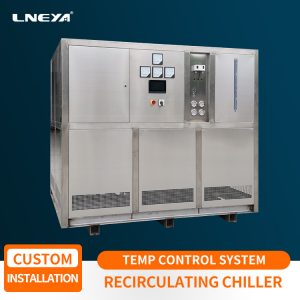
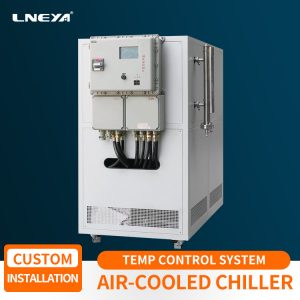
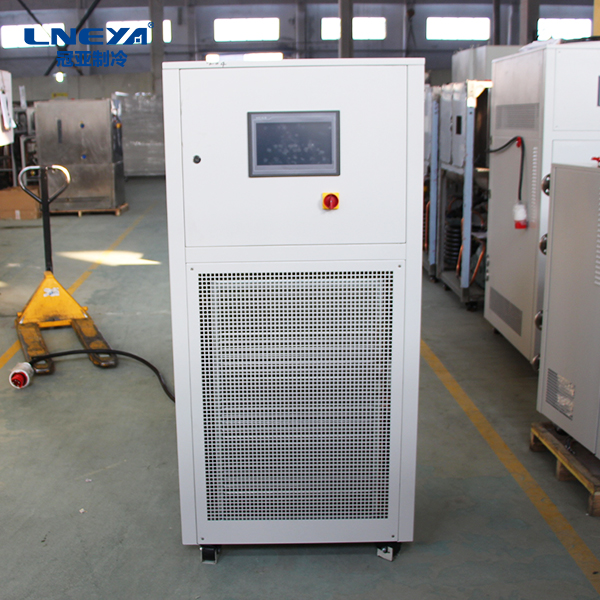
LNEYA microfluidic chip test mainly uses the refrigeration heating temperature control technology to conduct temperature control tests on test items and integrated circuits to meet the needs of various tests.
(Note: Some of the content is from related papers. If you infringe, please contact us in time to delete, thank you!)
Recomendações relacionadas
-

-80 °C pontos do equipamento de funcionamento do fabricante do frigorífico
1561Quando o utilizador escolhe o frigorífico de -80 °C, é definitivamente necessário ter uma qualidade fiável. O frigorífico Wuxi Guanya (LNEYA)-80 °C deve prestar atenção aos seus detalhes de funcionamento durante a operação para evitar a falha do equipamento causada por...
Ver detalhes -
Introdução do termóstato de circulação de aquecimento e arrefecimento LNEYA
1847Atualmente, o problema que assola a indústria farmacêutica e química é o problema do controlo da temperatura. Com a crescente procura da indústria e os requisitos de controlo de temperatura da indústria farmacêutica e química, a utilização de sistemas de...
Ver detalhes -
Etapas de depuração do refrigerador de água industrial na indústria química
1684Após a conclusão da instalação de refrigeradores de água industriais em empresas químicas, é necessário efetuar uma certa depuração na fase inicial da operação. Somente através de uma depuração cuidadosa podemos descobrir se há problemas ocultos em...
Ver detalhes -
Condições ambientais para a instalação de chillers arrefecidos a ar
1668Como todos sabemos, a instalação da maioria das máquinas tem de corresponder ao ambiente e às condições. Naturalmente, os nossos chillers industriais arrefecidos a ar não são exceção. Se o resfriador refrigerado a ar não for instalado pela primeira vez, ele trará muitos ...
Ver detalhes