 LNEYA Refrigeradores industriais Fabricante Fornecedor


API Reactor Cooling — Chiller Solutions and Temperature Control Strategies
An Active Pharmaceutical Ingredient (API) is the biologically active component in a drug responsible for its intended therapeutic effects. For example, the API in ibuprofen tablets is ibuprofen. Most APIs are complex organic compounds, and their production involves a variety of chemical reactions, including condensation, oxidation, reduction, and cyclization.
These reactions release significant amounts of heat. Insufficient cooling can degrade the API and pose significant process safety risks. Therefore, refrigeradores industriais or sistemas de controlo dinâmico de temperatura are essential equipment for pharmaceutical reactors.
Challenges of Pharmaceutical Reactor Temperature Control
Highly Exothermic Reactions
Many chemical reactions in API manufacturing rapidly release significant amounts of heat once initiated. Failure to dissipate this heat in a timely manner can lead to thermal runaway. You might think that thermal runaway simply halts the reaction and compromises product quality. In reality, some reactions at high temperatures can produce CO2 or hazardous gases, which can increase pressure in a sealed reactor and create a significant risk of explosion and leakage.
Multi-Stage Temperature Control
The complete API synthesis process typically involves multiple stages, including reaction initiation, main reaction, intermediate transformation, and controlled crystallization, each with different temperature requirements. At the start of the reaction, the reaction rate must be controlled by temperature control.
During the main reaction phase, the reactants should be slowly heated within the reactor. During the intermediate conversion phase, the temperature should be lowered to a range suitable for the intermediate conversion.
During the crystallization phase, the reaction solution should be cooled to a low temperature and maintained at a constant temperature to ensure uniform crystallization of the product. A chiller with only simple cooling and heating functions cannot meet complex temperature control requirements.
Contamination
Because APIs are intended for human use, they require extremely high cleanliness levels. Any impurities can compromise the purity, safety, and efficacy of the drug. Although the reactor cooling system does not directly contact the API, if an open-loop cooling system is used, or if the system employs non-pharmaceutical-grade coolant and has potential leak points, contamination risks increase.
Pharmaceutical Reactor Temperature Control Solutions
Controle preciso de temperatura
Industrial chillers use multiple Sensores Pt100 for sampling at the coolant inlet and outlet, as well as within the reactor. This high sampling frequency and low error allow for real-time monitoring of temperature fluctuations within the reactor.
Furthermore, the control system utilizes a PID algorithm to automatically adjust cooling and heating power based on changes in heat load, preventing temperature overshoot or undershoot. The system supports multiple levels of temperature precision, which can be tailored to specific process requirements.
Multi-step Temperature Profile
The temperature profile control function allows you to pre-program the reaction process in stages, including parameters such as target temperature, ramp rates, and hold time. Once programmed, the chiller automatically executes the program, switching between cooling and heating. Furthermore, temperature curves can be saved and reused, helping to improve reaction consistency.

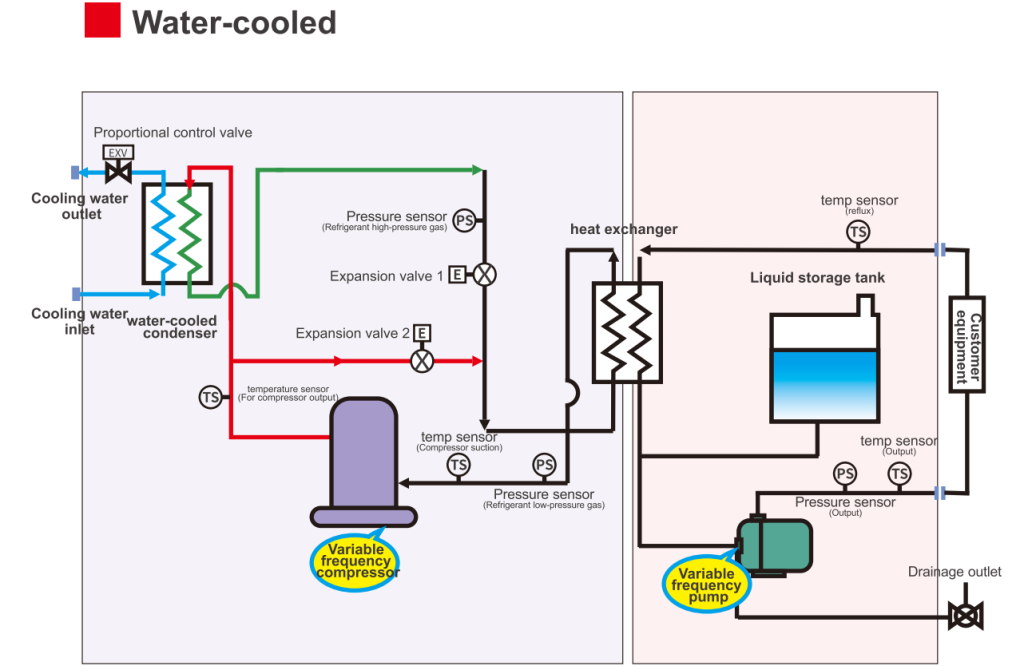
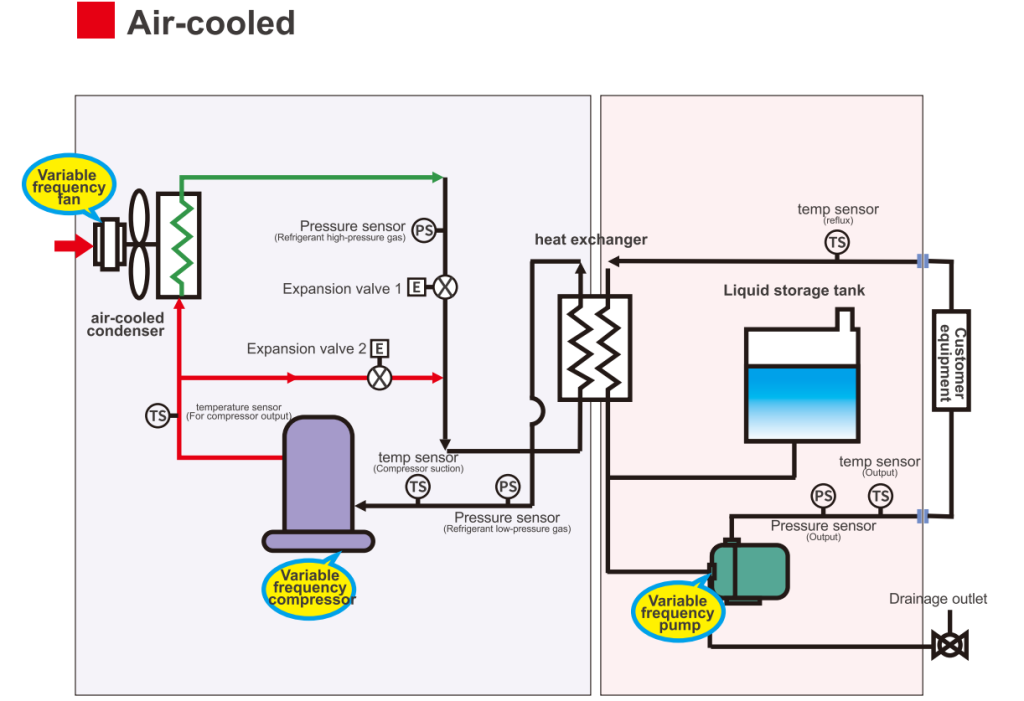
Closed-Loop System
While any small leak in an open cooling system could indirectly enter the reactor, a closed-loop chiller prevents contact between the coolant and the reactants at the source. The coolant in a closed-loop system has no direct contact with air, preventing coolant oxidation, moisture absorption, or evaporation, even under elevated temperatures. This prevents impurities such as air, dust, and microorganisms from entering the circulation system, ensuring compliance with cleanroom standards.
Quick Response
To avoid rapid temperature increases that can lead to product quality degradation and safety hazards, pharmaceutical reactor chillers must react instantly to temperature fluctuations, rapidly adjusting cooling and heating power to restore the reaction temperature to the target. This involves technical specifications such as temperature stabilization time, temperature adjustment slope, and heat load response delay.
Common Chillers for API Reactor Cooling
Common pharmaceutical reactor cooling equipment includes the following:
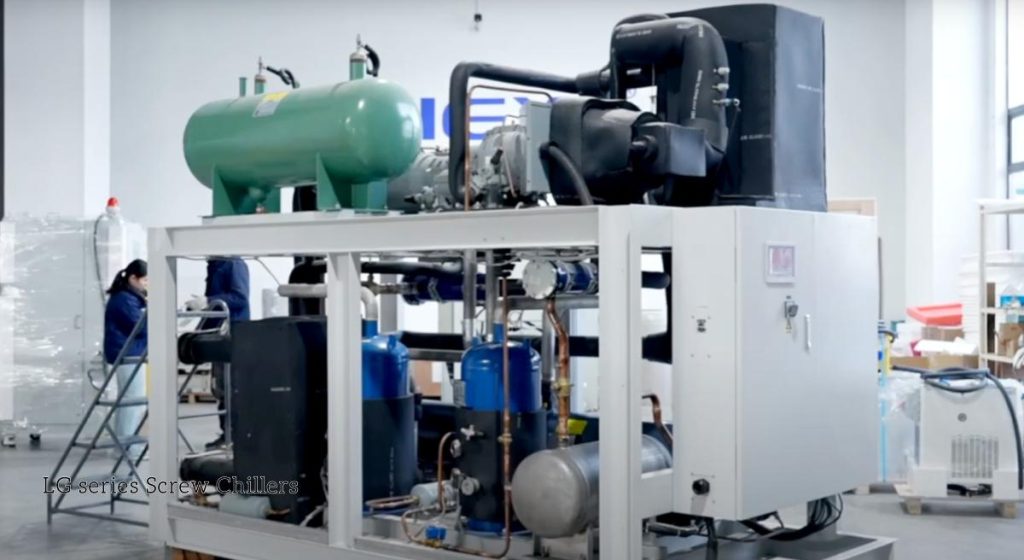
Low-Temperature Chillers
Low-temperature chillers can quickly remove heat generated by the reaction, maintaining process temperatures from -50°C up to ambient conditions. They are essential for low-temperature reaction stages in API production, such as crystallization, condensation, and purification.
Sistemas de controle de temperatura dinâmica
Dynamic temperature control systems are integrated temperature control solutions that combine heating and cooling functions. They are suitable for reactions requiring precise control of temperature gradients and can be used with glass reactors, jacketed reactors, and kettle reactors. These systems are ideal for processes with fluctuating thermal loads and rapid temperature transitions.
Explosion-Proof Chillers
The solvents used in API synthesis may be flammable. Explosion-proof chillers are essential in such hazardous environments to prevent sparks or high temperatures from causing safety hazards.

Conclusão
If you’re looking for a sistema de arrefecimento for your pharmaceutical reactor, LNEYA is happy to provide selection advice and a detailed quote. We have extensive experience designing and producing reactor chillers for numerous pharmaceutical companies and can customize a design based on your application.

Blogues recentes
- What Does a 200 Ton Chiller Cost
- Temperature Control in Photolithography
- Is a Used Chiller a Good Idea
- Chiller Components and Refrigeration Fundamentals Guides
Catálogo
- Dezembro 2025
- Novembro 2025
- Outubro 2025
- Setembro 2025
- Agosto 2025
- Julho 2025
- Junho 2025
- Maio 2025
- Março 2025
- Fevereiro 2025
- Janeiro 2025
- Dezembro 2024
- Novembro 2024
- Outubro 2024
- Setembro 2024
- Agosto 2024
- Julho 2024
- Junho 2024
- Maio 2024
- Abril 2024
- Março 2024
- Fevereiro 2024
- Setembro 2023
- Julho 2023
- Junho 2023
- Maio 2023
- Janeiro 2023
Etiqueta
refrigerador arrefecido a ar refrigerador Instalação de chillers Chiller Maintenance chiller refrigerant refrigeradores Congelador de montagem a frio refrigerador de refrigeração sistema de arrefecimento e aquecimento sistema de arrefecimento sistema de controlo dinâmico da temperatura chiller energeticamente eficiente refrigerador à prova de explosão congelador circulador de aquecimento refrigerador industrial refrigeradores industriais arrefecimento industrial congelador industrial frigorífico industrial reator de camisa refrigerador de laboratório refrigerador de baixa temperatura notícias refrigerador de óleo refrigerador de processo resfriamento de processo refrigerador do reator arrefecimento do reator arrefecimento do reator aquecimento aquecimento do reator arrefecimento bomba de circulação refrigerada refrigerador de parafuso refrigerador de semicondutores refrigerador de teste de semicondutores sundi tcu controlo da temperatura câmara de ensaio termóstato refrigerador de temperatura ultra baixa refrigerador de ensaio de veículos refrigerador de água refrigerador arrefecido a água
Contactar-nos
Refrigeradores relacionados


FALE CONOSCO
TEL:
EMAIL:
WeChat & WhatsApp:

Wechat QR

Tem alguma pergunta ou precisa de um orçamento? Preencha o formulário abaixo e nossa equipe entrará em contato dentro de 24 horas.

