LNEYA Refrigeradores industriais Fabricante Fornecedor


Changes in temperature control methods during semiconductor testing
As the use of semiconductor devices expands into new areas, such as automotive electronics, stricter requirements are imposed on their performance. Example: Devices are now required to operate at very low temperatures (about -40°C). To determine whether a particular semiconductor device will operate at these temperatures, the device needs to be fabricated. Testing must be performed at low temperatures before it can be delivered to customers. Conventional methods for testing semiconductor devices at low temperatures include placing a plurality of such devices in a conventional temperature chamber and reducing the ambient temperature therein to the required test temperature. The limitation of this method is that it usually takes about half an hour to reduce the temperature in the chamber to the test temperature. Due to the limited number of devices that can be installed in a given chamber, a half-hour cycle occurs every time a new batch of devices is tested. For production line technology, such long wait times are quite inefficient.
Low temperature test method, which not only reduces the time required to reach the test temperature, but is also compatible with current production line technology. In order to control the temperature of the chuck and thus the temperature of the wafer under test, tool designers have used a variety of techniques. In theory, pure water is very suitable for temperature control of chucks. Its limitations are obvious: Under normal atmospheric pressure, water cannot be used at temperatures below freezing or above boiling point. For actual wafer test operations, the range of 0°C to 100°C is too narrow.
By using a mixture of water and glycol similar to the antifreeze used in automotive radiators, a partial solution to the problem of narrow temperature ranges can be found. This mixture can significantly extend the operating temperature range. Thermal systems using water or water / glycol mixtures as coolants are rarely used in semiconductor testing. They can be used over a wide temperature range, typically around -70°C to + 120°C. Compared to water, even compared to purified water, the cost of synthetic coolants is high. Since these liquids evaporate over time even in closed circuits, the system needs to be refilled periodically.

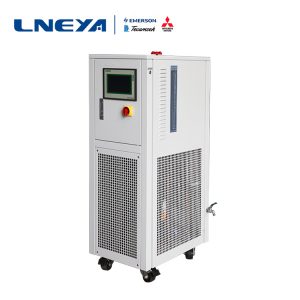
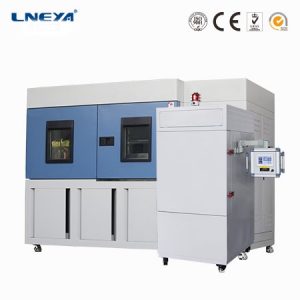
Aiming at the problems in the semiconductor test industry, LNEYA independently developed and generated a semiconductor test cooling and heating system, which is mainly used for temperature test simulation in semiconductor testing. It has a wide temperature orientation and high temperature rise and fall. The temperature range is -92°C ~ 250°C, suitable for various test requirements. LNEYA is committed to solving the problem of temperature control hysteresis in electronic components. Ultra-high temperature cooling technology can directly cool from 300°C.
The working principle of the cooling and heating system is through the heating and cooling process of the heat-conducting liquid / refrigerant inside the device, taking away the heat on the test bench through the input / output / heating the required heating device to meet the test temperature requirements.
This series of cooling and heating system equipment is suitable for precise temperature control of electronic components. Especially used in the manufacture of semiconductor electronic components in harsh environments, the assembly of IC packages and the engineering and production test stages include electronic thermal testing and other environmental test simulations at temperatures (-45°C to + 250°C). Once put into practical use, these semiconductor devices and electronics can be exposed to extreme environmental conditions to meet stringent military and telecommunications reliability standards.
Recomendações relacionadas
-
Collocation Requirements For Lab Water Chiller
1720The lab water chiller is a relatively advanced cryopreservation equipment, which is suitable for blood stations, hospitals, health and epidemic prevention systems, scientific research institutes, electronic industry, chemical medicine, biological ...
Ver detalhes -

Product features of explosion-proof high and low temperature machine
2052LNEYA explosion-proof high and low temperature machine is a relatively temperature control equipment that can be used in the current heating and cooling system. It can be used for simultaneous cooling and heating. It can be combined with various r...
Ver detalhes -
Como substituir o compressor scroll do modelo de testador de impacto?
2168Em termos de diferentes modelos de testadores de impacto, a configuração também é um pouco diferente. Entre eles, deve ser tomado um cuidado especial quando a substituição do scroll é um compressor. Se a substituição não for notada, o testador de impacto não pode ser usado. O ...
Ver detalhes -
Qual é o equipamento que uma fábrica de produtos químicos utiliza para aquecer um circulador de aquecimento?
1802Nas fábricas de produtos químicos, os circuladores de aquecimento são amplamente utilizados para aquecer uma variedade de equipamentos e dispositivos essenciais, a fim de garantir que as reacções e os processos químicos sejam realizados em condições de temperatura adequadas. Seguem-se alguns dos principais...
Ver detalhes