LNEYA Refrigeradores industriais Fabricante Fornecedor


Análise do trabalho e da aplicação industrial do refrigerador
Although there are many different types of chillers, most use the same cooling principle. An important part of the process is the coolant or refrigerant, which holds more heat than water and helps maintain an efficient cooling process. Heat is removed from the coolant and released into the air. The concept of a cooler is based on the principle that cooling involves removing heat from a process and releasing it into the air.
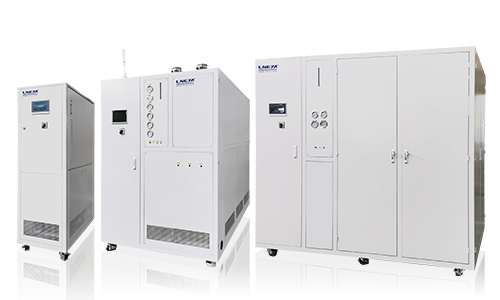
All chillers have condensers, compressors, expansion valves and evaporators for circulating fluid or refrigerant. The process of the cooler is designed to convert the refrigerant from liquid to vapor and then back to liquid. The refrigerant removes the heat from the process in the form of vapor. When it returns to liquid state through the compressor and condenser, it circulates through the system to capture heat from the process or operation.
On a manufacturing floor, when equipment is fully operational, temperatures can rise rapidly, creating an unsuitable work environment. To keep employees safe, industrial operations use coolers to keep working conditions at the right temperature. By adding an air handler, the chiller can cool the work area with cool air, just like an air conditioner. Depending on the building, air-cooled chillers can be installed on top of the building or inside.
Pharmaceutical:
Pharmaceuticals use chilled water in the manufacturing process and require precise temperature control. Chillers have the accuracy and precision of a chilled process and can be central process chillers or compact process chillers. The four basic types of pharmaceutical chillers are reciprocating, screw driven, centrifugal and absorption.
industry:
Industrial operations generate heat through the use of friction, high-power equipment, and furnaces or ovens. To extend the life of heavy equipment, chillers circulate cooling liquid through the equipment to maintain efficiency and productivity.
Water-cooled chillers:
Water-cooled chillers are often combined with cooling towers and use a condenser water treatment system to remove mineral deposits. The cooling tower sends water to the chiller for cooling.
Air-cooled chillers:
Air-cooled chillers are used where discharge is not an issue. It absorbs heat from the water and transfers it to the air: first, the heat of the circulating chilled water is absorbed in the evaporator, then the refrigerant condenses in the condenser and releases the heat into the air.
Low temperature chiller:
Low temperature chillers are suitable for industries that operate below freezing and require chillers capable of producing – 40° F (-40° C) temperatures. They are used in ice rinks, petrochemical cooling, chemical extraction, medical, pharmaceutical and food processing industries, as well as in product testing laboratories.
Recomendações relacionadas
-

Introdução profissional e aplicação da máquina de circulação de água para arrefecimento
1594A máquina de arrefecimento de água (o chiller, também conhecido como refrigerador) é um dispositivo de circulação de água arrefecida a ar que não necessita de uma torre de água fria. Trata-se de uma conceção arrefecida por compressor, concebida para máquinas, instrumentos científicos ou produ...
Ver detalhes -
Sistema de aquecimento por refrigeração LNEYA star SUNDI-320/420W/430W
1862Hoje, vou apresentar o modelo do sistema de aquecimento por refrigeração da LNEYA: SUNDI-320/420W/430W. Tem três tipos de faixa de temperatura média: -30°C~180°C; -40°C~180°C; -40°C~200°C. O sistema de controlo está programado para programar até 10 programas...
Ver detalhes -
Descrição do lubrificante do sistema de arrefecimento circulante do motor do automóvel elétrico LNEYA
1704O sistema de arrefecimento circulante do motor do veículo elétrico é utilizado no ensaio de baterias de veículos de energia nova. Por isso, os requisitos de desempenho são muito elevados. Entre eles, o óleo lubrificante do sistema de arrefecimento de circulação do motor do veículo elétrico tem um certo ...
Ver detalhes -
Aplicação de TCU em sistemas de refrigeração e de circulação de calor
1840No processo de síntese farmacêutica e operação de química fina, encontramos frequentemente reacções exotérmicas fortes, como a reação de oxidação e a neutralização ácido-base. No caso destas reacções exotérmicas fortes, se o controlo for inadequado ou a...
Ver detalhes