 LNEYA Refrigeradores industriais Fabricante Fornecedor


Como escolher um chiller para arrefecimento do reator
Picking the right refrigerador for a reactor system isn’t just a numbers game. Sure, specs matter—but what matters more is how your process actually runs. You need to understand how heat builds and moves through the system, how your reactor reacts to those shifts, and just how tightly you need to keep the temperature in check to get consistent results.
A lot of systems fall short because someone chose a chiller based purely on reactor size—or worse, picked a cooling unit designed for HVAC, not for handling dynamic chemical reactions. That kind of shortcut usually comes back to bite you.
This guide cuts through the noise. We’ll walk through how to find a chiller that fits your real-world application, avoids the usual headaches, and keeps your system running smoothly from batch to batch.
Start with the Heat Load
Before locking in a chiller, think through how your system behaves under real conditions.
Is your reaction throwing off heat as it runs? Or are you feeding it heat to keep things moving? That alone will steer you toward very different cooling needs.
Also consider how aggressive your temperature changes are. Are you gradually bringing things up to temp—or dropping it fast, like during crystallization or a quench?
Some systems just need to stay steady. Others need the chiller to track sharp temperature swings and respond quickly. A 1000-liter reactor handling an exothermic polymerization, for instance, doesn’t just need cooling power on paper—it needs a unit that can keep up in real time when the reaction spikes.
And here’s a lesson from the field: going slightly bigger with your chiller is often better than not big enough. But don’t go overboard. An oversized unit that cycles on and off too frequently can actually make temperature control worse, not better.
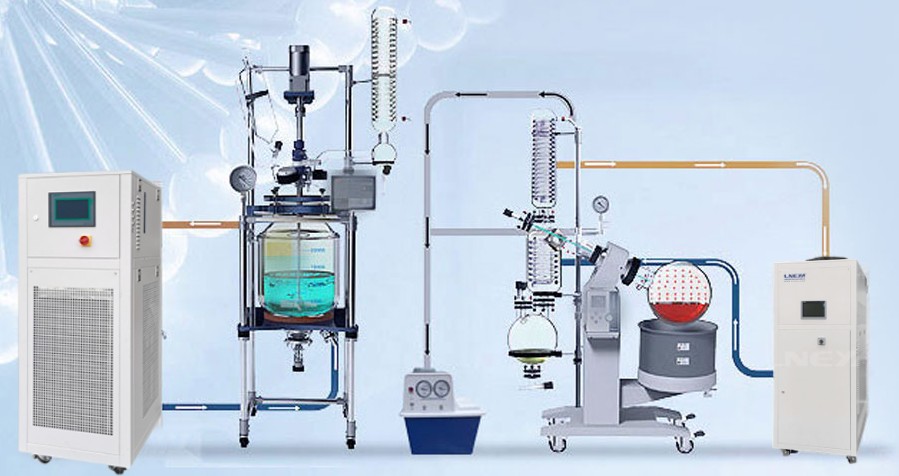
Temperature Range and Fluid Compatibility
Not every chiller is built for low temps, and not every fluid works well across wide ranges.If your target temperature is below 0°C and above -40°C, a glycol-water blend is the best budget-friendly option. However, if you need to cool down to -80°C or even below -100°C, it will thicken or freeze, and óleo térmico will maintain good fluidity and heat transfer efficiency at these temperatures. Furthermore, if your reactor system involves high temperatures, an oil that is less likely to volatilize and degrade at high temperatures is the best choice.
Remember that all hoses, reactor jackets, and seals that come into contact with the coolant are subject to high and low temperatures and thermal stress. If the coolant you choose is incompatible with the materials of these components, it could slowly corrode your system. This is crucial to keep in mind if you want to avoid expensive equipment repairs.
Lastly, if your process calls for really extreme temperatures, just having a good coolant isn’t enough. You’ll probably want a cascade chiller or something similar that’s built to handle those tough cooling demands reliably.
Match the Chiller to Your Reactor’s Personality
Reactors have personalities—at least thermally speaking.A jacketed glass reactor in a lab behaves very differently than a 2000L stainless steel tank with a thick wall and baffles. What you’re cooling isn’t just fluid—it’s a heat-retaining, moving system that resists change.
There are many issues to keep in mind. For example, glass reactors react fast to cooling but are more sensitive to thermal shock. Metal reactors retain heat longer and need higher-capacity systems for rapid shifts. Batch processes often require fast ramping and soak periods. Continuous systems demand stable, constant control over long periods.
Make sure your industrial chiller can not only reach your target temperature—but hold it, recover from spikes, and cycle predictably through your process phases.
Flow Rate and Pressure
Even if your chiller’s temperature control is perfect, if it can’t move the fluid through your jacket effectively, it won’t matter. Think about the size and design of your reactor jacket and piping—too low a flow can cause stagnant zones, while too high pressure might stress seals and fittings. Matching your pump’s capacity to the system’s needs ensures smooth, reliable operation.
Control Features
You’re not buying a chiller to “just cool.” You’re buying it to control a chemical process. Here are a few features that matter in real-world use:
• PID loop integration for tight temp control
• Programmable ramp/soak profiles for complex reactions
• Modbus/Ethernet support if you want to integrate into a PLC or SCADA system
• Alarm systems and auto-shutdowns to prevent runaway heat events
If you’re using automation in your plant or lab, make sure the chiller speaks the same language as your controller.
Size and Reliability
It’s tempting to size your chiller “just enough” to get the job done. But what about:
• Hot summer days?
• Running two reactors in parallel next quarter?
• Your facility’s voltage fluctuations or limited 3-phase supply?
A good chiller unit isn’t just about capacity. It’s about reliability under real conditions—dust, vibration, 24/7 operation, operator error. Choose a chiller supplier with a proven industrial track record and support you can actually reach.
Considerações finais
Picking the right chiller isn’t just an engineering task—it’s a process design decision. When done right, your chiller becomes an invisible backbone of your operation. You barely notice it. The reaction runs clean, the batch finishes on time, and you don’t have to worry about thermal surprises. But when it’s wrong? You’re chasing noise, fighting lag, and praying the coolant doesn’t boil off mid-run.
The best sistema de arrefecimento isn’t the most powerful—it’s the one that actually works with your chemistry. So take your time. Think holistically. Talk to vendors who understand reactor cooling and refrigeration.
LNEYA offers a wide range of resfriadores de processo for reactors of varying types and capacities. Our equipment is currently operating smoothly in the reactor systems of numerous companies. Interested in exploring collaborative projects or customizing your reactor cooling system? Contact us today.

Blogues recentes
- What Does a 200 Ton Chiller Cost
- Temperature Control in Photolithography
- Is a Used Chiller a Good Idea
- Chiller Components and Refrigeration Fundamentals Guides
- Chiller Types and Selection Guides
- How Does a Peltier Cooler Work
- Peltier Chiller vs. Compressor Chiller
- What Is a Peltier Chiller
Catálogo
- Dezembro 2025
- Novembro 2025
- Outubro 2025
- Setembro 2025
- Agosto 2025
- Julho 2025
- Junho 2025
- Maio 2025
- Março 2025
- Fevereiro 2025
- Janeiro 2025
- Dezembro 2024
- Novembro 2024
- Outubro 2024
- Setembro 2024
- Agosto 2024
- Julho 2024
- Junho 2024
- Maio 2024
- Abril 2024
- Março 2024
- Fevereiro 2024
- Setembro 2023
- Julho 2023
- Junho 2023
- Maio 2023
- Janeiro 2023
Etiqueta
refrigerador arrefecido a ar refrigerador Instalação de chillers Chiller Maintenance chiller refrigerant refrigeradores Congelador de montagem a frio refrigerador de refrigeração circulador de arrefecimento e aquecimento sistema de arrefecimento e aquecimento sistema de arrefecimento sistema de controlo dinâmico da temperatura chiller energeticamente eficiente refrigerador à prova de explosão congelador circulador de aquecimento refrigerador industrial refrigeradores industriais arrefecimento industrial congelador industrial frigorífico industrial reator de camisa refrigerador de laboratório refrigerador de baixa temperatura notícias refrigerador de óleo refrigerador de processo resfriamento de processo refrigerador do reator arrefecimento do reator arrefecimento do reator aquecimento aquecimento do reator arrefecimento bomba de circulação refrigerada refrigerador de parafuso refrigerador de semicondutores refrigerador de teste de semicondutores sundi tcu controlo da temperatura câmara de ensaio termóstato refrigerador de temperatura ultra baixa refrigerador de ensaio de veículos refrigerador de água refrigerador arrefecido a água
Contactar-nos
Refrigeradores relacionados


FALE CONOSCO
TEL:
EMAIL:
WeChat & WhatsApp:

Wechat QR

Tem alguma pergunta ou precisa de um orçamento? Preencha o formulário abaixo e nossa equipe entrará em contato dentro de 24 horas.

